Life as It Could Be
What if the AI doesn't just animate the world — what if it finds the world worth animating?

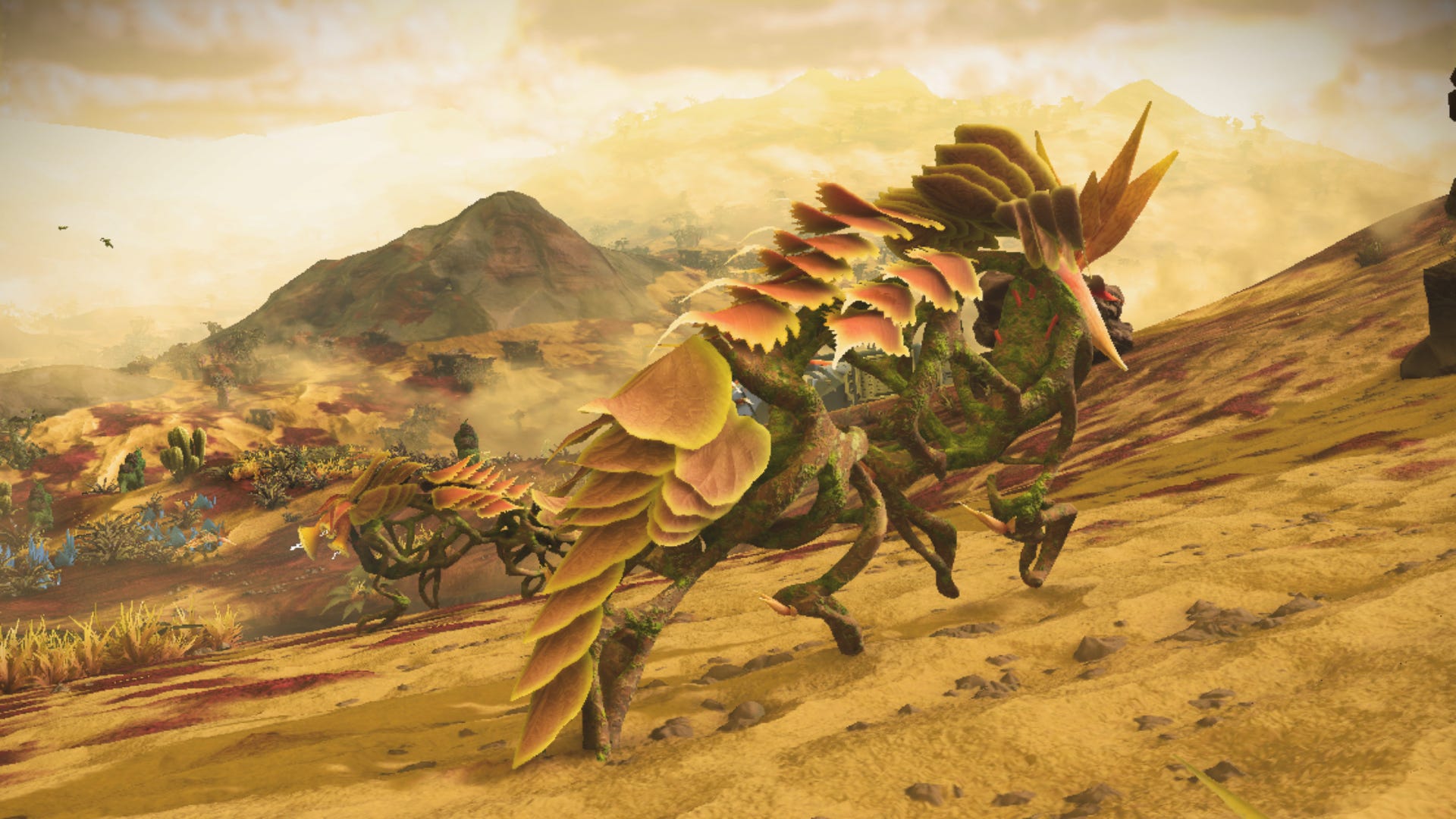
In a game called No Man’s Sky there are 18 quintillion planets. You can land on any of them. Each one has terrain, weather, creatures. Predators stalk prey in packs. Herbivores graze and flee when threatened. Parents defend their young. It’s more ecologically sophisticated than most people give it credit for.
But watch closely and you notice what’s missing. When a predator kills prey, the prey population doesn’t decline. The grass doesn’t grow back faster because grazing pressure dropped. The soil doesn’t cycle nutrients. The behaviors are real — the predator really does hunt — but they’re not coupled through the environment. Remove every plant and the animals don’t starve. Drain every water source and nothing gets thirsty. The ecology is behavioral, not systemic.
There’s a deeper architectural reason for this. No Man’s Sky runs its creatures client-side. They spawn around you as you explore. Two players standing on the same planet can see different animals in different positions doing different things. There’s no shared simulation to be coherent about, because there’s no simulation — there’s a behavior layer on top of a spawn system. The ecology can’t be systemic because there’s no persistent world state for systems to couple through.
Eighteen quintillion worlds, each with real predator-prey behavior, none of it connected to anything underneath. The diversity is visual and behavioral. The ecology is a surface.
I don’t bring this up to criticize No Man’s Sky. It’s a remarkable game that solved a genuinely hard problem in procedural generation at scale. I bring it up because it illustrates a gap — the space between worlds that behave and worlds that work. And I think that gap is about to close, because of a collision between two fields that don’t usually talk to each other.
The Problem with Rules
In the first version of līlā, every species in the ecosystem engine was hand-crafted. Deer had their own foraging logic, their own hunger thresholds, their own hardcoded interactions with grass. Butterflies had a separate pollination routine with hand-tuned linger times and flower cooldowns. Five species, twenty tuning milestones, hours of trial and error documented in a file called lessons_learned.md.
It worked. A temperate meadow emerged — deer grazing, butterflies pollinating, soil moisture shifting, dormant plants recovering after rain. Quite predictably I noticed something painful about the process: adding a sixth species wouldn’t be additive. It would be multiplicative. A wolf doesn’t just need wolf code. It needs wolf-deer interaction code, wolf-butterfly non-interaction code, wolf-grass indirect-effect code. Every new species potentially interacts with every existing one. The design effort scales as O(n²). At five species, that’s manageable. At fifty, it’s intractable.
This is the fundamental problem with encoding ecological knowledge as rules. Rules are specific, brittle, and combinatorial. You write them one pair at a time, test them in isolation, then discover emergent interactions you didn’t anticipate. The lessons_learned file is full of these: “pollination needs cooldowns on flowers, not memory on insects.” “Children must inherit parent stress or populations become immortal.” Every state transition needs a threshold to enter and a different threshold to exit — otherwise entities flicker between states sixty times a second, like a light switch being toggled by a nervous hand. Each lesson is a rule that was wrong until it was hand-fixed. Scale that process to a hundred species and you’ll need a hundred debugging sessions. Nobody has that kind of patience. Not even an AI.
The Trait Insight
Modern computational ecology solved this problem decades ago. The key insight is deceptively simple: most of the “rules” governing how organisms behave are derivable from a surprisingly small number of measurable traits.
The most powerful single trait is body mass.
From body mass alone, you can derive metabolic rate (Called Kleiber’s Law: BMR scales as mass^0.75), consumption rate (proportional to metabolic rate), movement speed (bigger animals move faster, but not linearly — there’s a power law), sensory range, home range size, lifespan, and reproductive rate. These aren’t rough guesses. They’re validated power laws that hold across orders of magnitude, from bacteria to blue whales. Max Kleiber published the metabolic scaling relationship in 1932. Nearly a century later, it still works.
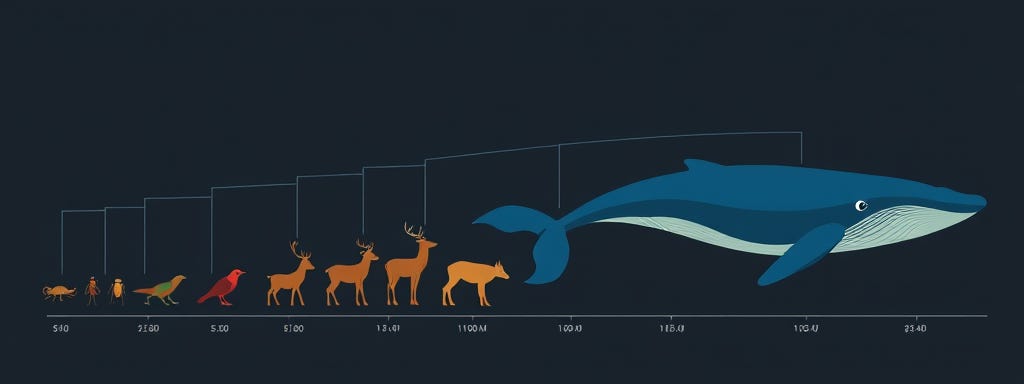
The Madingley Model — a general ecosystem model developed at Microsoft Research and the UN Environment Programme — proved that you can simulate ecosystems globally using measurable traits and scaling laws, with no species-specific code. Organisms are defined by body mass, diet type, whether they’re warm or cold-blooded, and how they reproduce. Everything else is derived. Tundra, rainforest, coral reef — same engine, different trait distributions.
This means a species doesn’t have to be a page of handwritten rules. It can be a point in trait space:
{
  "species_id": "wolf",
  "body_mass_kg": 40.0,
  "diet": "carnivore",
  "eats": ["herbivores"],
  "warm_blooded": true,
  "locomotion": "quadruped",
  "reproduction": "few_offspring_high_investment"
}
The engine reads that and derives everything else. Hunger rate? Computed from body mass via Kleiber’s Law. Movement speed? Scaling laws. What does it eat? The predation template matches its diet against other species, constrained by body mass ratios — predators typically take prey between a tenth and twice their own size. Deer flee? The engine sees a 40 kg carnivore within sensory range and triggers the flee response — no wolf-specific code needed.
Adding a wolf becomes a JSON file, not a debugging session.
The Search
Here’s where it gets curiouser.
Akarsh Kumar, at MIT and Sakana AI, published a paper called “Automating the Search for Artificial Life with Foundation Models.” The core idea: take an artificial life simulation — Boids, Particle Life, Conway’s Game of Life, Lenia — and use a vision-language model (like CLIP) to automatically search for the most interesting configurations.
The method, called ASAL, works like this. You define a substrate — a parameterized simulation. You define an objective — what you’re looking for. Then you let evolutionary search (CMA-ES) explore the parameter space, using the foundation model to evaluate each candidate by embedding rendered frames into a latent space and measuring how well they match the objective.
Three objectives, three modes of discovery:
Target search. You give it a text prompt — “a caterpillar” — and it finds the Particle Life configuration that produces dynamics matching that prompt in CLIP space. The system discovers a pattern that looks and behaves like a caterpillar, from particles that have no concept of caterpillars.
Open-endedness. No prompt. Just: find the simulation that keeps producing novel patterns the longest. The system discovers cellular automata that are more open-ended than Conway’s Game of Life — automata nobody had found through decades of manual exploration.
Illumination. Find the most diverse set of interesting simulations. Map the entire space of possible behaviors for a substrate. The output is a Simulation Atlas — a UMAP projection showing every discovered configuration, organized by visual similarity. An atlas of possible worlds.
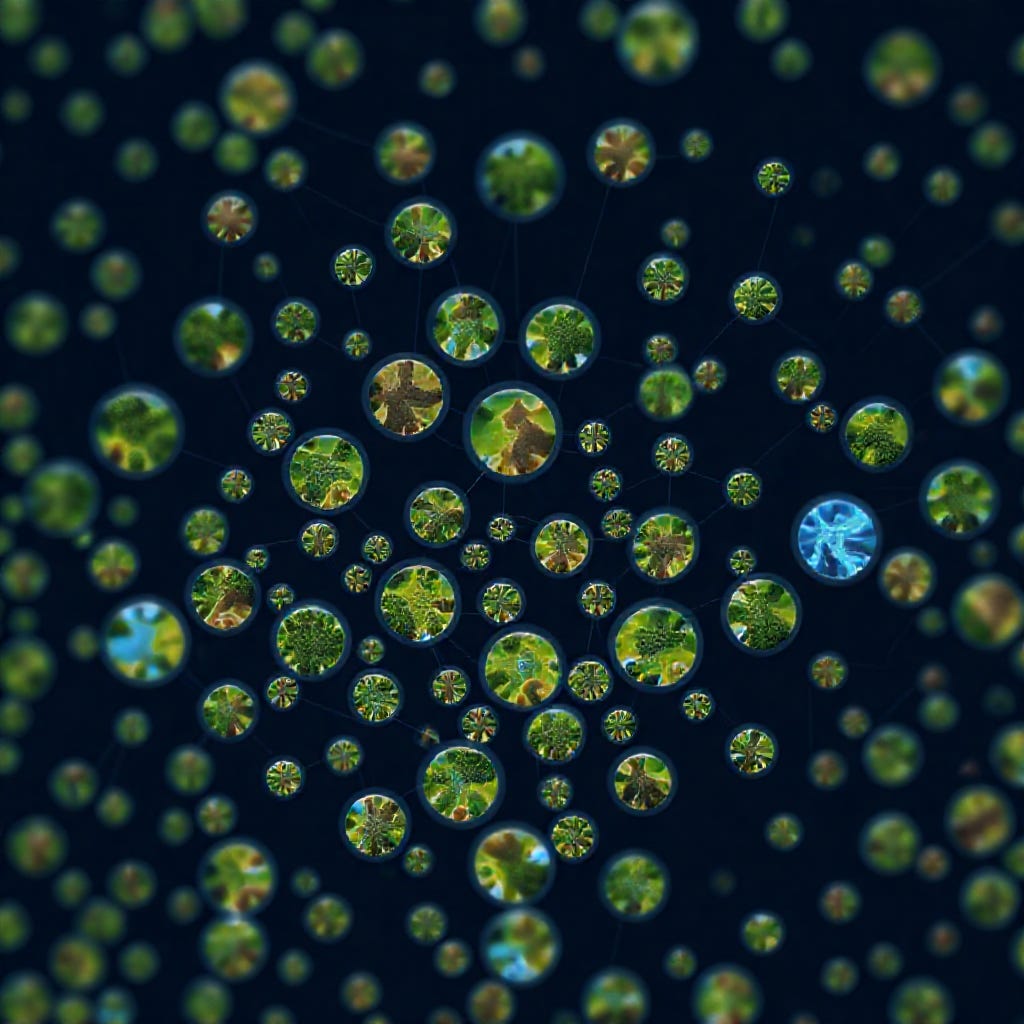
The results are remarkable. But there’s a limitation that Akarsh himself points to. In the paper’s conclusion, he writes: “The most insightful substrates bake in as little information as possible, while maintaining vast emergent capabilities.” The current substrates — Boids, Lenia, Game of Life — are computationally elegant but ecologically empty. A Lenia pattern that CLIP matches to “a cell” isn’t modeling nutrient uptake. A Boids flock that looks like fish isn’t competing for food. The emergence is visual, not functional. The patterns are interesting to look at. They’re not interesting to an ecologist.
The Collision
What if the substrate had ecological semantics?
What if, instead of searching through abstract rule spaces hoping emergence looks biological, you started with a simulation where the rules are biological — scaling laws that govern metabolism, food web interactions, nutrient cycling — and searched for the trait configurations that produce the most interesting dynamics?
That’s what happens when you combine the trait-based engine with ASAL-style search.
The user types: “a tidally locked planet with extreme temperature gradients — one side baking, one side frozen, a narrow habitable strip where everything competes for the temperate zone.”
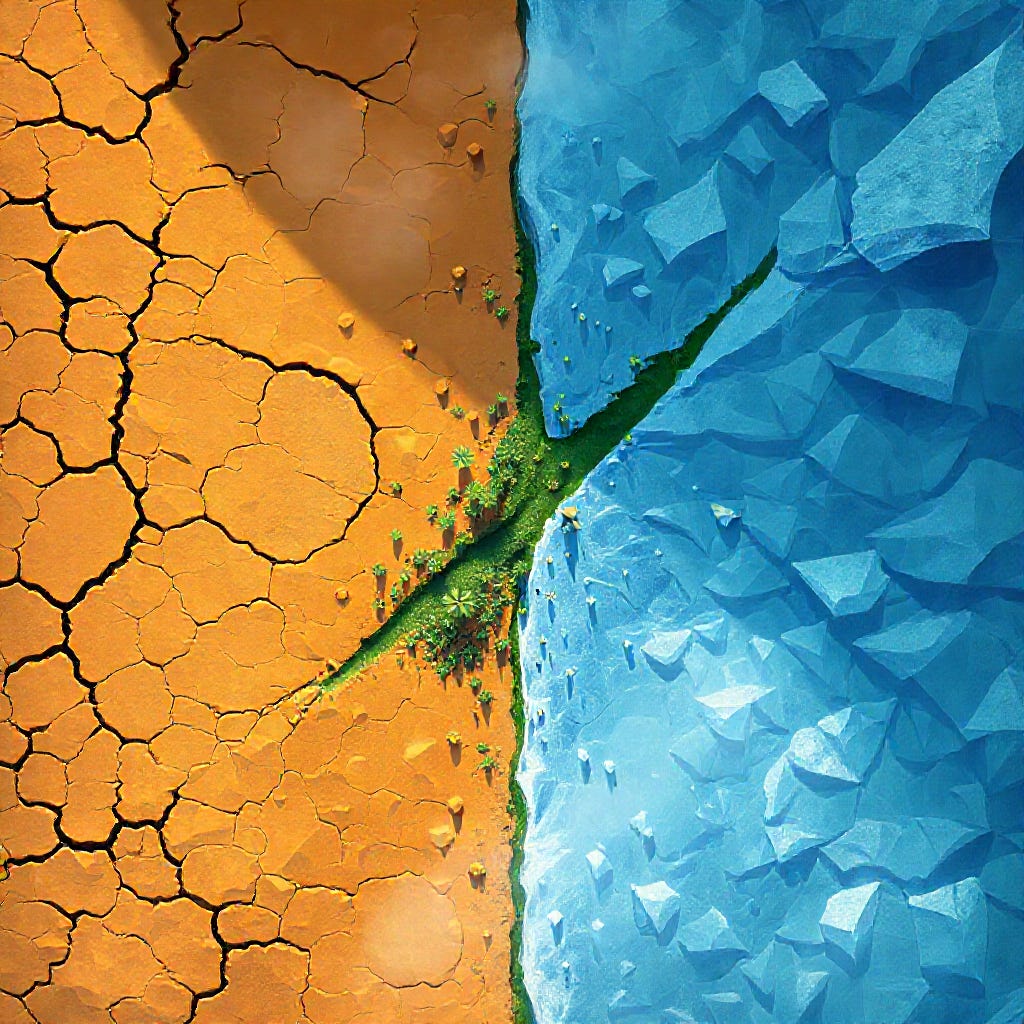
The search doesn’t pick from a menu of biome templates. It explores trait space — body masses, thermal tolerances, locomotion modes, drought resistances, diets — looking for the community of organisms whose emergent dynamics best match that description in CLIP space.
It might find something nobody designed: a tough, immobile plant with extreme heat tolerance that anchors the habitable strip. A small warm-blooded grazer that follows the terminator line, tracking the temperature gradient. A predator that ambushes at the cold boundary where prey slow down. None of that was authored. The scaling laws derived the metabolic rates. The interaction templates produced the food web. The search found the configuration. The engine ran it forward and the dynamics emerged.
Two people who type the same prompt get different ecosystems. The search is stochastic. Both results match “tidally locked habitable strip” in CLIP space, but one might be predator-dominated with population oscillations and the other might be a stable web of mutual dependence. Different ecological solutions to the same environmental constraint. That’s not a bug — that’s convergent evolution in miniature.
Alien Physics
Here’s where it goes further than I originally intended.
The scaling laws in the engine are Earth’s scaling laws. Kleiber’s exponent is 0.75 because of how our vascular networks distribute nutrients under our gravity, in our atmosphere, at our temperature range. But in the engine, those exponents are just constants in derivation functions. They’re numbers in a file.
On a high-gravity planet, the speed-mass exponent could drop. Everything would be slower and squatter. On a low-gravity planet with dense atmosphere, flight becomes viable at much higher body masses. The insect flight ceiling goes up. Megafauna take to the air.
The scaling exponents themselves become searchable dimensions. The system isn’t just searching for interesting trait combinations within Earth physics. It’s searching for interesting physics that produce interesting ecologies. “What Kleiber exponent produces the most open-ended dynamics?” is a question with real scientific content. And the answer might not be 0.75.
The ASAL paper’s conclusion imagines searching for worlds that start as “simple cells in primordial soup,” undergo “a Cambrian explosion of complexity,” and eventually become “an artificial alien civilization.” With a substrate that has ecological semantics — metabolism, food web structure, nutrient cycling — that trajectory isn’t just a visual metaphor. It’s a sequence of functional ecological transitions. The Cambrian explosion wasn’t a visual event. It was a metabolic revolution. An ecologically-grounded substrate can model that distinction.
What This Is
I keep trying to find the category for what this becomes and failing. It’s not a game — there’s no win condition, no score, no authored narrative. It’s not a research tool — it’s too approximate, too stylized, too focused on emergence over prediction. It’s not a visualization — the worlds aren’t data, they’re generated. It’s not generative art — the aesthetics are secondary to the ecological coherence.
The closest analogy is a holodeck for ecologies. You describe a world. The system finds a plausible version of it. You enter it. You watch. You perturb it — trigger rain, introduce a predator, change the gravity — and watch the consequences emerge from first principles. Not scripted consequences. Not pre-authored responses. Consequences that follow from body mass and metabolic rate and food web structure, the same way real consequences do.
Eighteen quintillion planets, each with creatures that hunt and flee and defend their young, none of it coupled to the world underneath. Or a smaller number of worlds where everything is connected — where rain changes soil, soil changes plants, plants change herbivores, herbivores change predators, and predators change everything else. I know which one I want to explore.
The Hands
“The Unseen Hand” argued that the most impactful AI is small and invisible — a 500-parameter network producing a 4-dimensional latent vector that nobody sees, but that makes the difference between something that moves and something that behaves.
That’s still true. But there are two unseen hands now.
The first operates at the motor level. It runs every tick, at 10 Hz, turning context vectors into motion latents. It makes the deer walk like a deer. Nobody sees it working.
The second operates at the cosmological level. It runs before the simulation starts, exploring the space of possible worlds, guided by a foundation model’s sense of what’s interesting. It finds the ecology worth simulating. Nobody sees it searching.
One hand animates the world. The other hand finds it.
līlā is open source at github.com/hellolifeforms/lila. The trait-based architecture and ASAL substrate integration are in active development. Follow the project @hellolifeforms on Bluesky.